


Choosing the best cyber security certifications Australia as a beginner can feel overwhelming there are dozens of options, and not all of them carry weight with Australian employers. This guide narrows it down to seven certifications that genuinely help beginners land their first role, compares them head-to-head, and breaks down where demand is strongest across Sydney, Melbourne, Brisbane, Perth, Adelaide, and Canberra. If you’re searching for cyber security courses for beginners in Australia, start here.
Why Choose an Entry-Level Cyber Security Certification?
Cyber security remains one of Australia’s fastest-growing technology sectors, with strong, sustained demand across government, banking, healthcare, and critical infrastructure. Most Australian employers hiring for entry-level roles specifically want candidates with a recognised certification rather than a lengthy resume it’s proof you understand core security concepts without requiring years of on-the-job training. A solid entry-level certification is also significantly faster and cheaper than a university degree, making it the most practical starting point for career changers.
Who Should Read This Guide?
This guide is written for complete beginners IT support staff looking to specialise, career changers with no technical background, recent graduates, and anyone exploring cyber security courses for beginners in Australia for the first time. If you already hold an intermediate or advanced certification like CISSP or CISM, this guide won’t be the right fit it’s focused entirely on the first step in.
Best Entry-Level Cyber Security Certifications in Australia
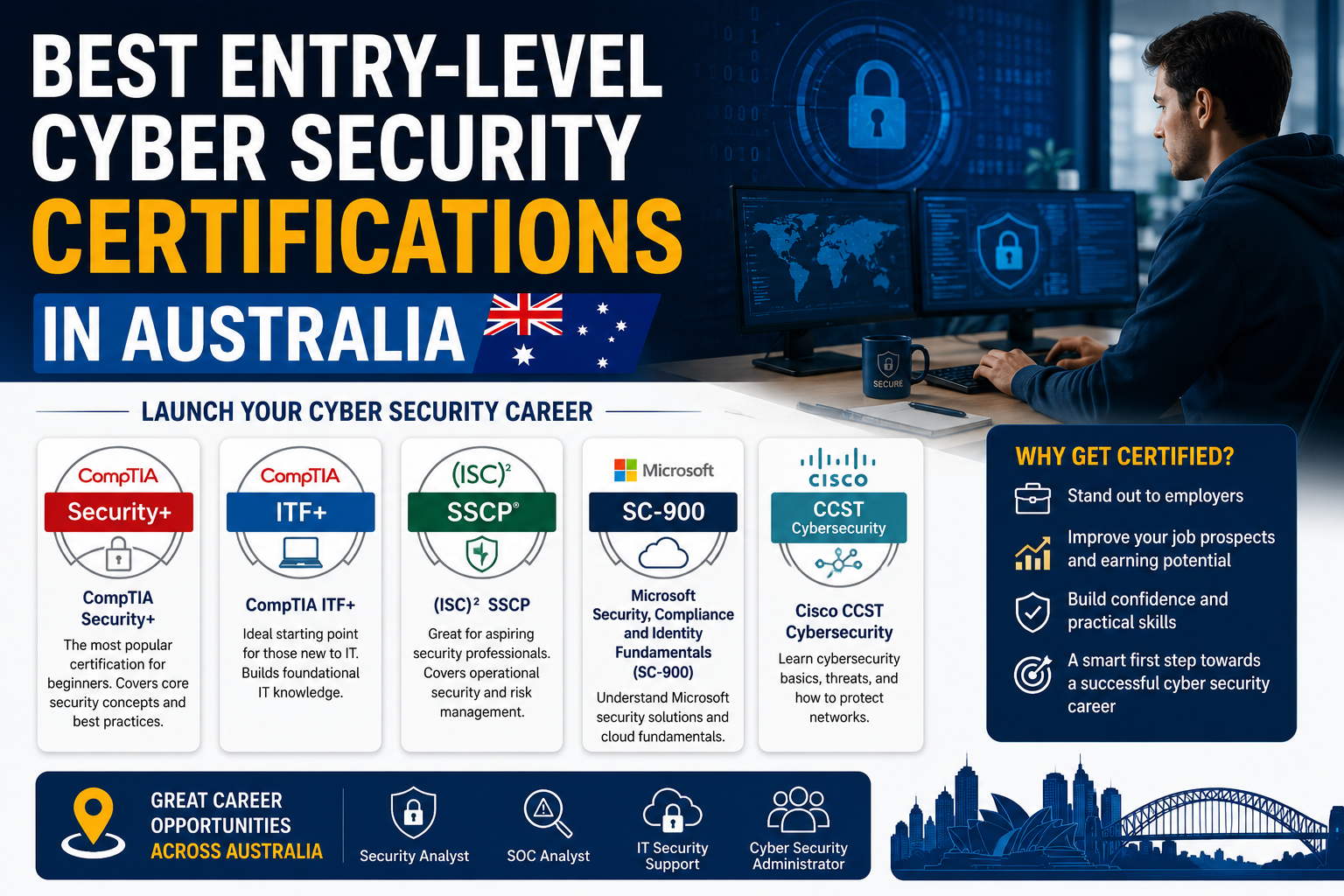
These seven certifications are the ones most consistently recognised by Australian employers for entry-level cyber security roles.
1. CompTIA Security+
Widely regarded as the industry standard starting certification, CompTIA Security+ covers core security functions including threat identification, network security, and secure system design, with a strong focus on practical, hands-on skills rather than theory alone.
2. ISC2 Certified in Cybersecurity CC
Designed specifically for people with no prior experience, ISC2’s Certified in Cybersecurity covers foundational principles like the CIA triad, incident response basics, and governance, risk, and compliance a strong first certification before progressing to more advanced ISC2 credentials.
3. Microsoft Security, Compliance, and Identity Fundamentals SC-900
A good fit for beginners already working in Microsoft-based environments, SC-900 covers security, compliance, and identity concepts across Microsoft 365 and Azure at a foundational level.
4. Microsoft Security Operations Analyst SC-200
A step up from SC-900, this certification focuses on threat detection and response using Microsoft security tools, making it a strong choice for beginners aiming specifically at SOC analyst roles.
5. Cisco CyberOps Associate
Well suited to SOC-focused career paths, covering security monitoring, event analysis, and incident response fundamentals using Cisco’s security operations framework.
6. Fortinet Cybersecurity Fundamentals
A free, beginner-friendly certification covering foundational network security concepts, popular with Australian employers running Fortinet firewalls and security appliances.
7. Google Cybersecurity Certificate
A flexible, self-paced online certificate covering security fundamentals, Python basics, and SQL, popular with beginners who prefer a structured online learning format over exam-only certifications.
Which Certification Should You Choose?
The right starting certification depends on your specific goal:
If You Are Completely New to Cyber Security
Start with ISC2 Certified in Cybersecurity or the Google Cybersecurity Certificate both are built for absolute beginners with no assumed experience.
If You Want to Become a Cyber Security Analyst
CompTIA Security+ is the strongest general-purpose choice, recognised across almost every Australian analyst job ad.
If You Want to Work in a SOC
Cisco CyberOps Associate or Microsoft SC-200 both align closely with day-to-day SOC analyst responsibilities.
If You Want to Start Cloud Security
Microsoft SC-900 is the natural starting point, especially if you’re already working in or around Microsoft 365 or Azure environments.
If You Want to Move Into Ethical Hacking Later
Start with CompTIA Security+ to build foundational knowledge before progressing toward penetration testing-focused certifications.
Best Cyber Security Certifications in Sydney
Sydney’s banking and financial services sector drives strong demand for CompTIA Security+ and ISC2-certified analysts, particularly for roles supporting regulatory compliance and risk management.
Best Cyber Security Certifications in Melbourne
Melbourne’s diverse employer base healthcare, education, and corporate services makes CompTIA Security+ and Microsoft SC-900 particularly versatile starting certifications for the local market.
Best Cyber Security Certifications in Brisbane
Brisbane’s growing government and infrastructure sector increasingly values Cisco CyberOps and CompTIA Security+ for SOC and network-focused entry-level roles.
Best Cyber Security Certifications in Perth
Perth’s resources and mining sector favours candidates with CompTIA Security+ or Fortinet certifications, reflecting the heavy use of operational technology and network security appliances on-site.
Best Cyber Security Certifications in Adelaide
Adelaide’s defence and space industry presence creates strong demand for ISC2 Certified in Cybersecurity and CompTIA Security+ as a pathway toward government security-cleared roles.
Best Cyber Security Certifications in Canberra
Canberra’s public sector and defence employers consistently favour CompTIA Security+ and ISC2 certifications, often as a prerequisite before applying for government security clearances.
CompTIA Security+ vs ISC2 CC: Which Is Better for Beginners?
ISC2 Certified in Cybersecurity is the gentler entry point broader, more conceptual, and designed for people with genuinely no prior IT background. CompTIA Security+ goes deeper technically and is more widely referenced in Australian job ads across analyst and support roles. Many beginners start with ISC2 CC to confirm the field is right for them, then move on to CompTIA Security+ as their primary job-ready credential.
Microsoft SC-900 vs SC-200: Which Should You Choose?
SC-900 is a broad foundations certification suited to anyone starting out in a Microsoft environment, covering security, compliance, and identity concepts at a high level. SC-200 is more specialised and technical, built specifically for security operations and threat response a better fit once you already have SC-900 or equivalent foundational knowledge and are targeting SOC analyst roles specifically.
FAQs About Entry-Level Cyber Security Certifications in Australia
What Is the Best Cyber Security Certification for Beginners in Australia?
CompTIA Security+ and ISC2 Certified in Cybersecurity are the two most widely recognised starting certifications across Australian employers.
Can I Get a Cyber Security Job With Only a Certification?
Yes, particularly for entry-level SOC analyst, IT security support, and junior analyst roles, though pairing a certification with hands-on labs or a home lab project strengthens applications significantly.
Which Certification Is Best for SOC Analyst Jobs?
Cisco CyberOps Associate and Microsoft SC-200 both align closely with SOC responsibilities, alongside a foundational CompTIA Security+ certification.
Do I Need a Degree to Start Cyber Security in Australia?
No. Most Australian employers hiring for entry-level roles accept recognised certifications and demonstrated practical skills in place of a formal degree.
Which City Is Best for Cyber Security Jobs in Australia?
Sydney and Melbourne carry the highest volume of roles overall, while Canberra leads for government and defence-focused positions. Check current listings on Seek to see exactly what’s being advertised in your city right now.
Start Your Cyber Security Career With the Right Certification
Picking from the best cyber security certifications in Australia doesn’t need to be complicated match the certification to your specific goal, whether that’s a SOC analyst role, cloud security, or a broad first step into the industry, and you’ll have a clear, credible pathway in. For a fuller roadmap covering entry-level roles, career progression, and salary benchmarks, our guide on how to start a cyber security career in Australia is a useful next read.
Ready to get certified?
Explore our cyber security certification training courses in Australia and take the first step toward a job-ready credential.