


Cyber security certifications Australia employers actually ask for follow a fairly predictable order, even though the sheer number of acronyms Security+, CySA+, PenTest+, SecurityX, AZ-500, CCST makes it feel confusing from the outside. This guide lays out the real beginner-to-advanced roadmap: which certification to get first, how CompTIA’s path compares to Cisco, Fortinet and Microsoft options, and which specialisation (blue team, red team, or cloud) makes sense once you’ve got the fundamentals down.
Whether you’re starting from scratch or already hold Security+ and want to know what’s next, this is the certification roadmap Australia’s cyber security job market is actually built around. For personalised advice on selecting the right cyber security certifications and training pathway, contact us on 1800 159 151 and speak with one of our learning consultants.
Why Cyber Security Certifications Matter for Australian Careers in 2026
Australia has a well-documented cyber security skills shortage, and recruiters routinely use certifications as a fast filter when they can’t personally assess every applicant’s hands-on skill. A recognised credential doesn’t replace real experience, but it does get your resume past the first screening particularly for SOC analyst, security analyst and junior penetration testing roles where employers need proof you understand the fundamentals before they invest in training you further.
The Cyber Security Certification Roadmap: Beginner to Advanced
Beginner Level Where to Start
For most people, CompTIA Security+ Australia is the correct starting point. It’s a vendor-neutral cyber security basics certification covering networks, threats, cryptography and security operations the shared foundation almost every other certification and every entry-level job ad assumes you already have. Full exam details sit on CompTIA’s official Security+ certification page.
Cisco Cybersecurity Associate Australia training (built around Cisco’s CCST Cybersecurity credential) is a solid alternative or companion certification if you’re coming from a networking background, since it leans more heavily on Cisco-specific tools and infrastructure than Security+’s vendor-neutral approach.
Intermediate Level Specialise Your Path
Once Security+ (or an equivalent beginner credential) is done, the roadmap splits into two common directions:
CompTIA CySA+ Australia the blue team path, focused on threat detection, monitoring and incident response. This is the natural certification for anyone aiming at a SOC analyst certification for beginners pathway or a security analyst certification Australia role, detailed on CompTIA’s official CySA+ certification page.
CompTIA PenTest+ Australia the red team path, covering ethical hacking, vulnerability assessment and penetration testing methodology, outlined on CompTIA’s official PenTest+ certification page.
Fortinet cybersecurity certification Australia training (the NSE program) is worth adding if you’re working with or targeting roles at organisations that run Fortinet firewalls and security infrastructure specifically common across Australian mid-size enterprise and managed service provider environments.
Advanced / Expert Level
CompTIA SecurityX Australia sits at the top of the CompTIA pathway. It replaced CompTIA’s former CASP+ credential and is built for senior security engineers and security architects — hands-on, performance-based, and positioned as the natural next step once Security+, and ideally CySA+ or PenTest+, are already in place. Details on the transition and current exam are on CompTIA’s official SecurityX certification page.
AZ-500 certification Australia (Microsoft Certified: Azure Security Engineer Associate) is the equivalent advanced step for anyone specialising in cloud security certification Australia rather than the general enterprise track increasingly relevant as more Australian organisations move core infrastructure into Azure. Microsoft’s exam details are on the official AZ-500 certification page.
Popular Certification Comparisons: Which Should You Choose?
Security+ vs CySA+
Security+ is broad and foundational; CySA+ is specialised in detection and response. If you’re brand new to cyber security, Security+ comes first CySA+ assumes that foundation and goes deeper into one specific direction.
Security+ vs PenTest+
Same relationship as above, but toward offensive security. PenTest+ assumes you already understand the fundamentals Security+ covers, then adds structured penetration testing methodology, tools and reporting on top.
CySA+ vs PenTest+
This is the real fork in the road: CySA+ suits people who want to monitor, detect and respond to threats (blue team, SOC-focused roles); PenTest+ suits people who want to find and exploit vulnerabilities before attackers do (red team, ethical hacking certification Australia pathway). Many professionals eventually pursue both, but pick based on which work genuinely interests you more the day-to-day tasks are quite different.
CEH vs PenTest+
Both cover ethical hacking, but PenTest+ leans more toward a structured, process-driven methodology and reporting, while CEH (Certified Ethical Hacker) has a longer industry history and slightly heavier brand recognition in some Australian government and defence-adjacent job ads. If you’re comparing cost and depth, PenTest+ is often the more accessible entry point into offensive security.
Security+ vs Cisco Cybersecurity Associate
Security+ is vendor-neutral and broadly recognised across almost any Australian employer; Cisco’s Cybersecurity Associate path is more useful if you’re already working with, or targeting roles inside, Cisco-heavy network environments specifically. For most beginners without a strong networking background already, Security+ remains the safer first choice.
AZ-500 vs Security+
These aren’t really competitors Security+ is the general foundation, AZ-500 is a specialised, cloud-specific certification that assumes you already understand core security concepts. Get Security+ first unless you’re moving directly into an existing Azure administration role and need cloud security certification Australia specifically and quickly.
Best Certification After Security+
The honest answer is: it depends on which direction interests you. CySA+ if you want to move toward SOC and detection work, PenTest+ if offensive security appeals more, or AZ-500 if you’re already working in a cloud-heavy environment and want to specialise there instead of the general CompTIA track.
Cyber Security Career Paths These Certifications Support
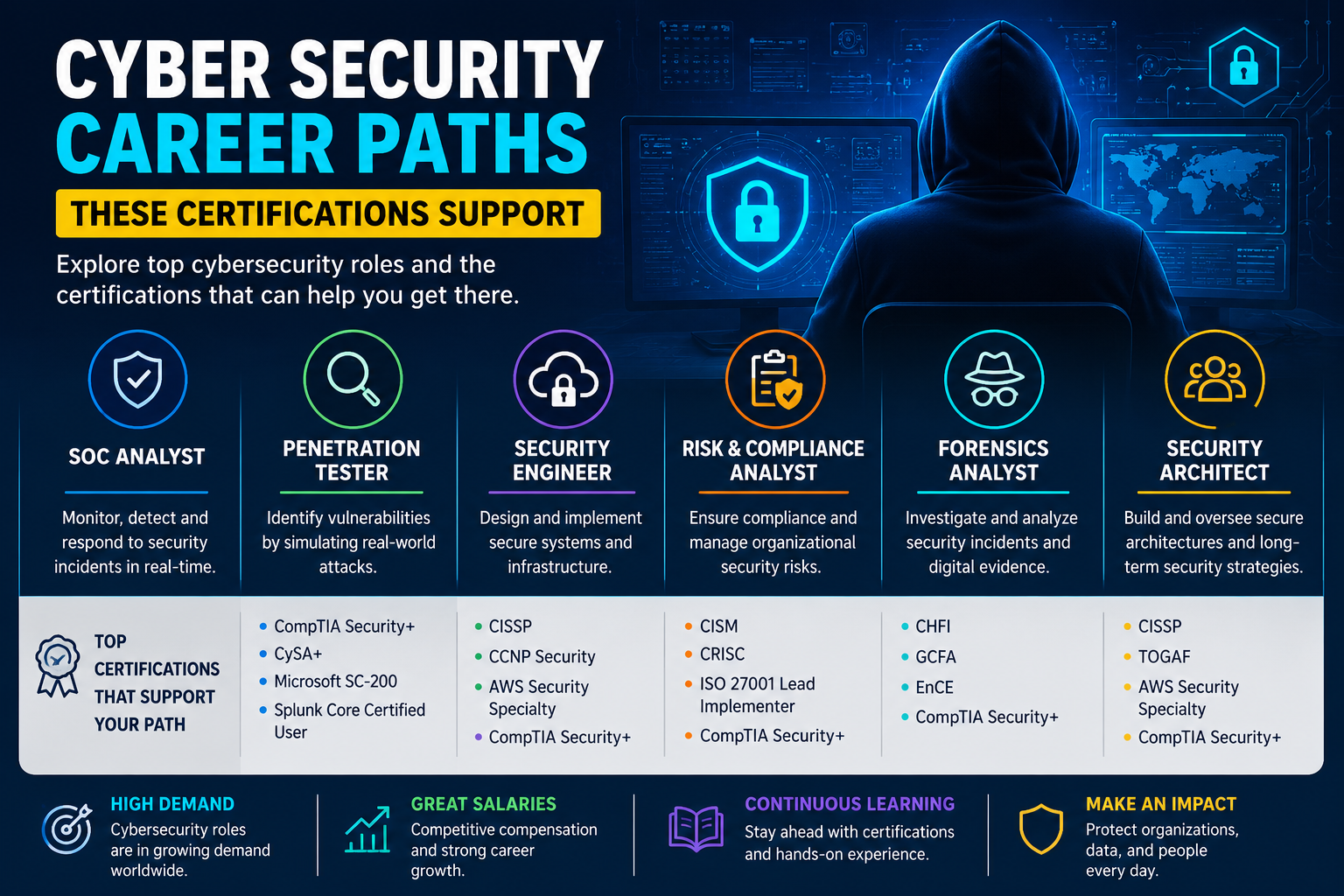
Security+ alone opens doors to junior security analyst, IT security support and SOC analyst career Australia entry-level roles. Adding CySA+ strengthens SOC analyst and incident response certification pathways specifically. PenTest+ (or CEH) supports junior penetration tester and vulnerability assessment roles. AZ-500 supports cloud security engineer positions, and SecurityX supports senior security engineer or security architect roles once you have several years of hands-on experience behind the certification itself none of these credentials substitute for real experience, but they structure the skills employers expect at each stage.
Cyber Security Training Across Melbourne, Sydney, Brisbane, Perth, Adelaide and Canberra
At Cyber Security Certifications Australia, training covers the full cyber security certification pathway Australia professionals follow from a beginner cyber security course Australia through to CySA+, PenTest+, SecurityX and AZ-500 preparation.
- Cyber security certification Melbourne and cyber security training Melbourne beginner through advanced pathways, including instructor-led options.
- Cyber security certification Sydney and cyber security course Sydney Security+, CySA+ and PenTest+ preparation for Sydney’s larger finance and government-adjacent employer base.
- Cyber security certification Brisbane and cyber security course Brisbane foundational and intermediate pathways suited to Brisbane’s growing tech and government sector demand.
- Cyber security certification Perth and cyber security course Perth raining aligned to Perth’s resources-sector security and infrastructure needs.
- Cyber security certification Adelaide and cyber security course Adelaide including defence-adjacent pathways relevant to Adelaide’s growing defence industry presence.
- Cyber security certification Canberra and cyber security course Canberra government and public sector-focused training, given Canberra’s concentration of federal agencies.
Every location also has online cyber security certification Australia and live online cyber security course Australia options, so you’re not limited to whichever city you happen to live in.
Choosing Between Online, Live Online and Instructor-Led Training
A cyber security course with certificate Australia delivered fully online and self-paced suits people fitting study around a current job, while instructor led cyber security training Australia (in person or live online) suits people who want structured pacing, direct access to a trainer, and a fixed exam date to work toward. Neither format is inherently better the right choice depends on how you personally stay accountable to finishing a course once you’ve started it.
Cyber Security Certifications Australia: Frequently Asked Questions
Which cyber security certification should I get first?
For almost everyone starting from zero, CompTIA Security+ is the right first certification. It’s vendor-neutral, broadly recognised, and assumed as prior knowledge by nearly every intermediate and advanced certification that follows it.
What is the best entry level cyber security certification in Australia?
CompTIA Security+ is the most consistently requested entry-level credential in Australian job ads. Cisco’s Cybersecurity Associate pathway is a strong alternative if you’re coming from a networking background specifically.
Do I need a degree as well as certifications to get a cyber security job in Australia?
Not necessarily. Many Australian cyber security professionals move into the field through certifications and hands-on practice (home labs, capture-the-flag exercises, entry-level IT roles) rather than a dedicated degree. A degree can help for graduate programs at larger organisations, but certifications carry real weight on their own for most SOC analyst and security analyst roles.
How long does it take to go from beginner to job-ready in cyber security?
Most people following a structured beginner cyber security course Australia path Security+, then a specialisation like CySA+ or PenTest+ reach a genuinely job-ready standard in six to twelve months of consistent study, faster with full-time, instructor-led training.
Is CompTIA SecurityX worth it, or should I stop at CySA+ or PenTest+?
SecurityX is aimed at senior security engineers and architects with substantial hands-on experience already it’s not a natural next step straight after Security+. Most people benefit more from CySA+ or PenTest+ first, building several years of real experience, and only then considering SecurityX once they’re operating at a senior level.
Are online cyber security certifications respected by Australian employers?
Yes, particularly for well-known vendor-neutral credentials like Security+, CySA+ and PenTest+. What matters to employers is the certification itself and evidence of practical skill (labs, projects, a home lab, prior IT experience) not whether you studied online or in a physical classroom.
Should I choose CySA+ or PenTest+ if I’m not sure which path I want?
If you’re genuinely unsure, CySA+ tends to be the safer first specialisation SOC analyst and detection-focused roles are more numerous at entry level than penetration testing roles, which often expect some prior security experience even at the junior level.
Final Thoughts
The cyber security certification roadmap Australia employers recognise is more straightforward than the acronym soup suggests: start with Security+, specialise into CySA+ or PenTest+ based on whether detection or offensive security interests you more, add AZ-500 if you’re moving toward cloud security, and consider SecurityX only once you’re operating at a senior level with real experience behind you. Pick a cyber security course Australia program that matches exactly where you are on that roadmap, and the certifications will do their job getting your resume seen, and giving you the structured knowledge to back it up once you’re in the room.