


Trying to map out a Cyber Security Certification Roadmap Australia but not sure where to start? Between Security+, CySA+, PenTest+, AZ-500, Fortinet, Cisco, and SecurityX, it’s easy to end up overwhelmed before you’ve even booked an exam. This guide breaks the roadmap down by career goal beginner, SOC analyst, penetration tester, cloud security, or senior technical practitioner with training available online and across Melbourne, Sydney, and Brisbane.
Why Cyber Security Certifications Matter in Australia
Australian organisations across banking, government, healthcare, and critical infrastructure need skilled cyber professionals to manage threats, protect systems, support compliance, and respond to incidents as they happen. Recognised certifications build exactly this practical capability threat detection, incident response, risk management, cloud security, and security operations giving employers a reliable, standardised way to screen candidates without needing years of prior experience as a prerequisite.
Best Beginner Cyber Security Certification Pathway
CompTIA Security+ remains the strongest starting point for beginners, IT support staff, help desk professionals, system administrators, and career changers moving into cyber security. It validates foundational, hands-on skills across enterprise security, hybrid environments, governance, risk, compliance, and incident response giving you a broad, vendor-neutral base before specialising into any of the pathways below.
Best Pathway for SOC Analyst and Blue Team Roles
For learners aiming at monitoring, detection, incident response, and security operations work, CompTIA CySA+, Cisco Cybersecurity Associate, and Microsoft’s Azure security-focused pathways are the strongest next steps after Security+. Each builds directly on foundational knowledge with a sharper focus on the day-to-day realities of SOC and blue team work log analysis, threat hunting, and structured incident response.
Best Pathway for Penetration Testing and Ethical Hacking
If vulnerability assessment, ethical hacking, and offensive security genuinely interest you, CompTIA PenTest+ is the recommended next certification after Security+. It’s delivered as a structured, multi-day certification training course across major Australian cities, giving you hands-on practice with the exact techniques penetration testers use to identify and report security weaknesses.
Best Pathway for Cloud Security Roles
For learners who want to secure cloud platforms and Microsoft-based environments specifically, Microsoft AZ-500 (Azure Security Engineer) is the clearest pathway. It’s available as a structured, multi-day course across Melbourne, Sydney, Brisbane, Adelaide, Canberra, and Perth, and builds naturally on Security+ foundations for anyone targeting Azure-specific security roles.
Best Pathway for Advanced Cyber Security Professionals
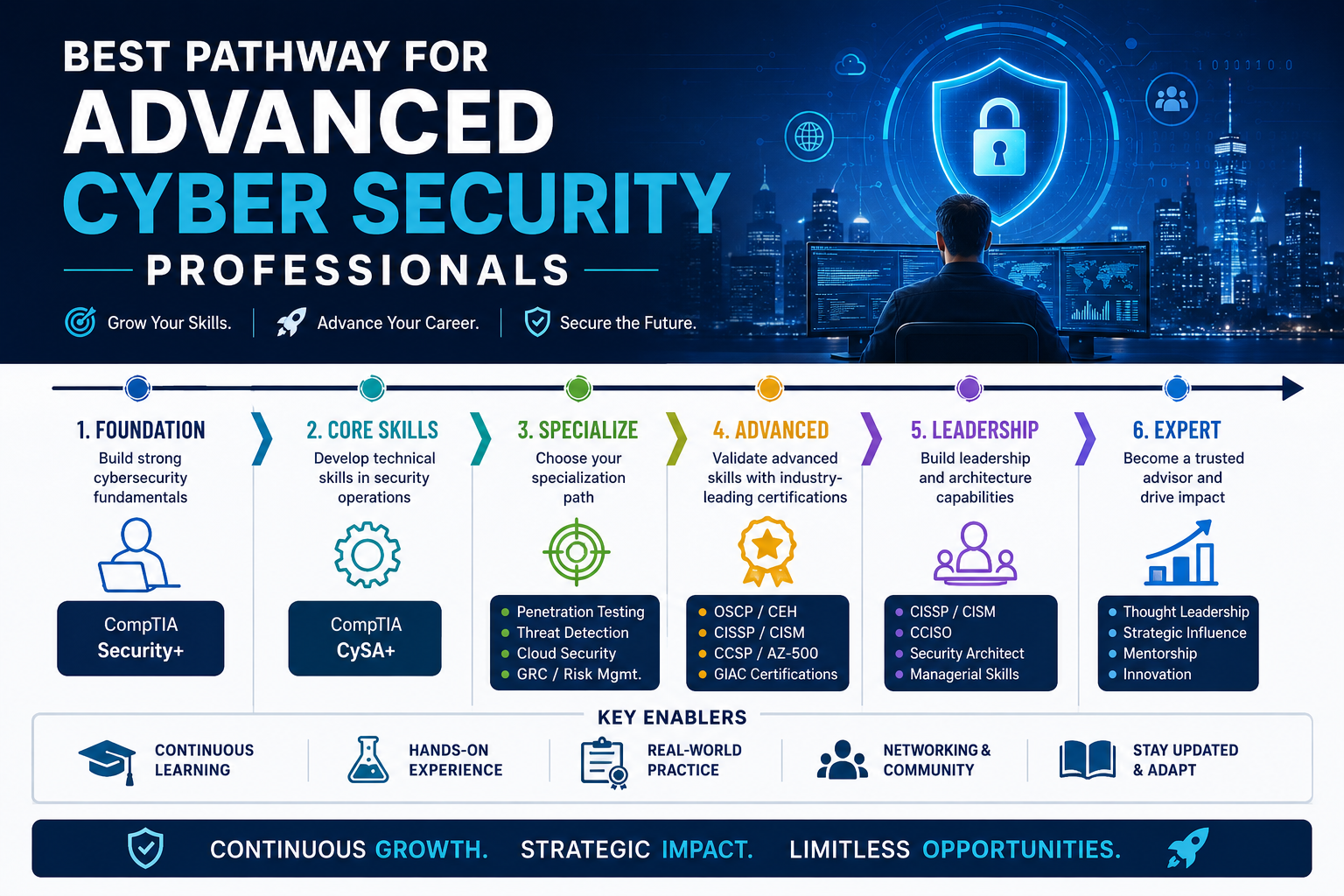
Experienced practitioners aiming for senior technical roles should look at CompTIA SecurityX (formerly CASP+). It’s aimed specifically at experienced security architects and senior security engineers working across cloud, on-premises, and hybrid environments a genuine step up from associate-level certifications like Security+ or CySA+, rather than another beginner-adjacent credential.
Which Certification Should You Choose?
Here’s a quick-reference roadmap matched to common career goals:
| Career Goal | Recommended Certification Path |
| New to cyber security | CompTIA Security+ |
| SOC analyst / blue team | Security+ → CySA+ |
| Pen testing / ethical hacking | Security+ → PenTest+ |
| Cloud security | Security+ → AZ-500 |
| Senior technical security | Security+ → CySA+/PenTest+ → SecurityX |
| Network/security operations | Cisco Cybersecurity Associate or Fortinet pathway |
Each of these pathways is fully supported across our course catalogue, spanning Security+, CySA+, PenTest+, SecurityX, Cisco, Fortinet, and Microsoft AZ-500 training.
Is Cyber Security a Good Career in Australia?
Yes, and the salary data reflects genuinely strong long-term demand. PayScale reports an average base salary for CompTIA Security+ holders in Australia of around $89,000, while SalaryExpert reports an average cyber security analyst salary in Melbourne of roughly $154,000. The gap between those figures reflects how much pay climbs as you move from an entry-level certification toward a dedicated analyst role and it keeps climbing further into security engineer, architect, manager, and CISO-level positions, each sitting in progressively higher salary bands.
Online vs Classroom Cyber Security Training in Australia
Cyber Security Certification Roadmap Australia is available flexibly, whether you prefer online study, in-person classroom delivery, or a mix of both depending on your role, schedule, and location. Live online training suits professionals studying around a full-time job, while classroom training in a major city adds direct instructor access and hands-on lab supervision both formats cover the same certification objectives, so the right choice comes down to how you learn best.
Frequently Asked Questions
What is a cyber security certification roadmap?
A cyber security certification roadmap is a structured guide that helps professionals choose the right certifications based on their experience level, career goals, and specialisation. It provides a clear progression from entry-level certifications such as CompTIA Security+ to advanced credentials like CISSP, CISM, CEH, and OSCP, helping individuals build expertise and advance their careers strategically.
Which cyber security certifications should beginners pursue in Australia?
Beginners typically start with foundational certifications such as CompTIA Security+, ISC2 Certified in Cybersecurity (CC), Microsoft Security Fundamentals, or Cisco Certified Support Technician (CCST) Cybersecurity. These certifications introduce essential security concepts and provide a solid foundation for more advanced cyber security roles and certifications.
What is the best cyber security certification pathway for experienced professionals?
Experienced professionals should align certifications with their career objectives. Security managers often pursue CISSP, CISM, or CRISC, while penetration testers may follow pathways leading to CEH, PNPT, OSEP, or OSCP. Cloud security specialists can benefit from certifications such as CCSP, AWS Security Specialty, or Microsoft AZ-500.
How long does it take to follow a cyber security certification roadmap?
The timeframe varies depending on your background, study commitment, and career goals. Entry-level certifications can often be achieved within a few months, while progressing to advanced certifications such as CISSP or OSCP may take several years of professional experience, hands-on practice, and continuous learning.
Why should I follow a cyber security certification roadmap?
Following a cyber security certification roadmap helps you avoid unnecessary certifications, identify the most relevant credentials for your desired role, and develop skills in a logical sequence. A structured roadmap can improve job opportunities, increase earning potential, and provide a clear path toward specialised cyber security careers in Australia.
Final Recommendation
- Choose Security+ if you are starting your cyber security career.
- Choose CySA+ if you want SOC analyst or blue-team skills.
- Choose PenTest+ if you want penetration testing and ethical hacking skills.
- Choose AZ-500 if you want Microsoft cloud security skills.
- Choose SecurityX if you are an experienced practitioner targeting senior security roles.
Ready to build the right cyber security roadmap for your career?
Explore our CompTIA Security+, CySA+, PenTest+, AZ-500, and SecurityX courses, available online and across major Australian cities.