


If you’re exploring how to become a SOC analyst in Australia, 2026 is a genuinely strong time to start. Security operations centres across Australian banks, government agencies, and managed security providers are hiring steadily for threat detection, SIEM, and incident response skills. This guide covers exactly what a SOC analyst does, the career path from entry-level to lead, the certifications that matter most — including Microsoft SC-200, CompTIA Security+, and CySA+ — and real salary and job market data across Sydney, Melbourne, Brisbane, Perth, Adelaide, and Canberra.
What Is a SOC Analyst?
A Security Operations Centre (SOC) analyst monitors an organisation’s systems and networks for suspicious activity, investigates alerts, and responds to genuine security incidents before they escalate. SOC analysts typically work within a dedicated security operations team, often on rotating shifts, using SIEM platforms to triage alerts around the clock.
Why SOC Analysts Are in Demand in Australia
Cyber threats against Australian organisations continue to grow in volume and sophistication, and almost every mid-to-large business now runs some form of security operations function, whether in-house or outsourced to a managed security provider. A scan of SOC analyst roles listed on Seek shows consistent hiring across banking, government, and defence-linked employers, with cyber security analyst salaries in Australia averaging between $105,000 and $125,000. It’s one of the most accessible entry points into the broader cyber security field, since most roles accept certifications in place of a university degree.
What Does a SOC Analyst Do?
Day to day, a SOC analyst monitors dashboards and alerts generated by security tools, investigates flagged activity to determine whether it’s a genuine threat or a false positive, escalates confirmed incidents following established playbooks, and documents findings for reporting and compliance purposes. Tier 1 analysts typically focus on initial triage, while more senior analysts handle deeper investigation and threat hunting.
SOC Analyst Career Path in Australia
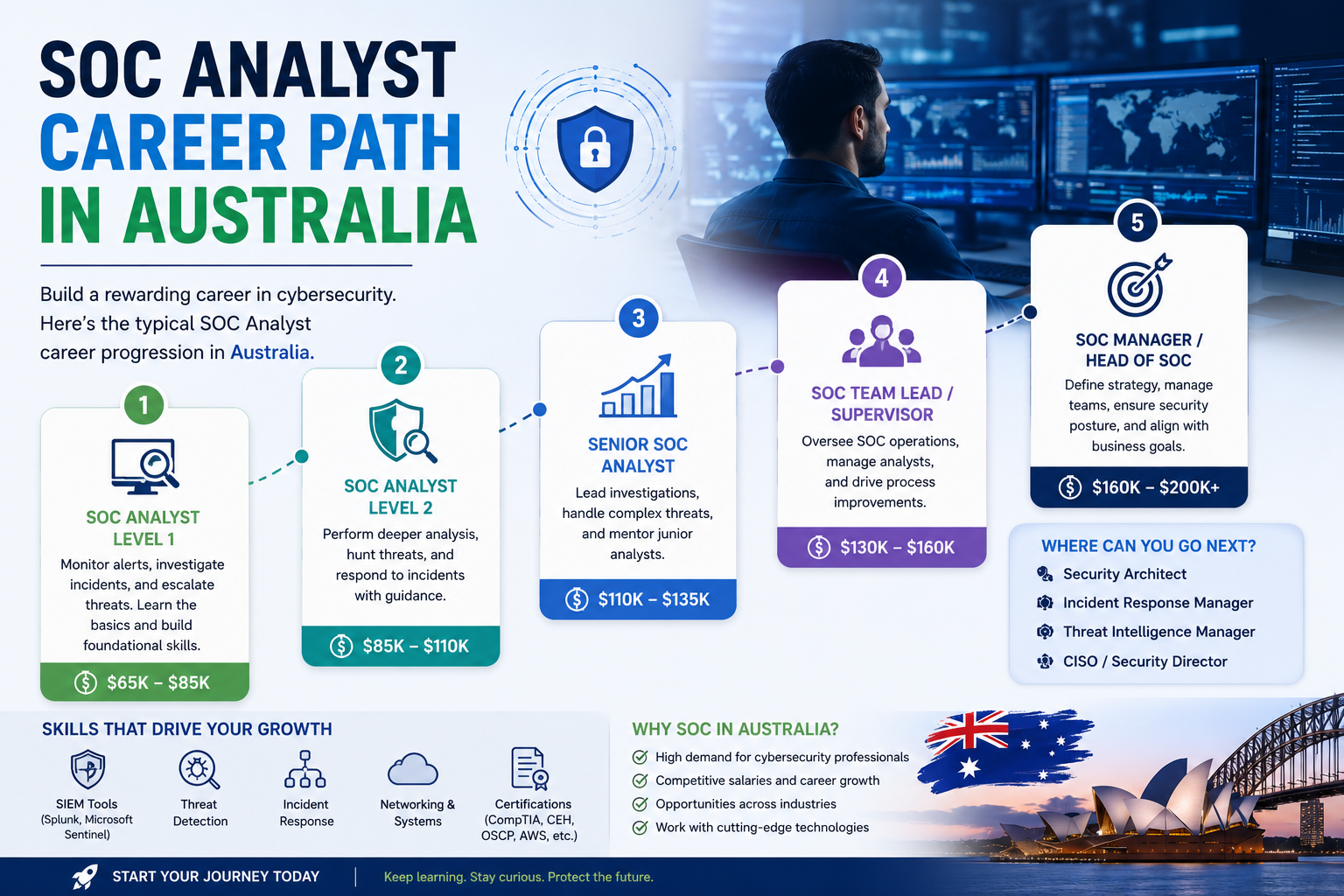
Most SOC careers in Australia follow a fairly predictable progression:
Entry-Level SOC Analyst
Tier 1 analysts focus on initial alert triage and escalation, following documented playbooks — the standard starting point for most SOC careers.
Cyber Security Analyst
A broader role covering risk assessments, vulnerability scanning, and deeper incident investigation, often the next step after twelve to eighteen months in a Tier 1 SOC role.
Incident Response Analyst
Specialises in investigating and containing confirmed security incidents, often working closely with forensics and legal teams on serious breaches.
Threat Hunter
Proactively searches for hidden or emerging threats that automated tools haven’t flagged, requiring deep familiarity with attacker techniques and behaviour.
Security Operations Lead
Manages a SOC team, oversees escalation processes, and reports on security posture to senior leadership — typically reached after several years of hands-on SOC experience.
Skills You Need to Become a SOC Analyst
These are the core, demonstrable skills Australian SOC teams look for:
Network Security Fundamentals
Understanding how firewalls, VPNs, and network protocols work is essential context for interpreting almost any security alert.
Log Analysis
Reading and interpreting system and network logs to determine whether activity is normal or suspicious — a genuinely core daily skill.
SIEM Tools
Comfort with SIEM platforms like Microsoft Sentinel or Splunk, since SIEM dashboards are where most SOC analyst work actually happens.
Incident Response
Knowing how to follow structured response processes when a genuine incident is confirmed, including containment and escalation steps.
Threat Detection
Recognising indicators of common attack techniques — phishing, malware, lateral movement — quickly enough to act before damage spreads.
Vulnerability Management
Understanding how vulnerabilities are identified, prioritised, and remediated across an organisation’s systems.
Cloud Security Basics
Increasingly essential as more Australian organisations run workloads on Azure or AWS, requiring SOC analysts to monitor cloud-based threats alongside traditional network ones.
Communication and Reporting
Clearly documenting incidents and explaining risk to non-technical stakeholders, which matters just as much as the technical investigation itself.
Best Certifications for SOC Analyst Roles in Australia
These certifications are the ones most consistently recognised across Australian SOC analyst job ads:
CompTIA Security+
The standard starting certification for almost any cyber security role in Australia, including SOC analyst positions. See CompTIA’s official Security+ page for current exam details.
Microsoft SC-200 Security Operations Analyst
Purpose-built for SOC roles, covering threat detection and response using Microsoft security tools — increasingly requested as more Australian organisations run Microsoft Sentinel.
Cisco CyberOps Associate
Well suited to SOC-focused career paths, covering security monitoring, event analysis, and incident response fundamentals.
CompTIA CySA+
An intermediate certification focused specifically on behavioural analytics, threat detection, and incident response — a strong next step after Security+ for SOC-focused careers.
Certified SOC Analyst — CSA
A vendor-specific certification focused entirely on SOC workflows, log analysis, and SIEM operations, useful for candidates wanting a highly targeted credential.
Fortinet Cybersecurity Certifications
Valuable for SOC roles at organisations running Fortinet security appliances, covering foundational network security monitoring concepts.
SOC Analyst vs Cyber Security Analyst: What Is the Difference?
A SOC analyst role is more narrowly focused on real-time monitoring, alert triage, and incident response within a security operations team. A cyber security analyst role is broader, often covering risk assessments, policy work, and vulnerability management alongside operational security tasks. Many professionals start as a SOC analyst before broadening into a general cyber security analyst position.
SOC Analyst vs Penetration Tester: Which Career Path Is Better?
SOC analyst roles are defensive, focused on detecting and responding to real threats as they happen, and are generally more accessible for beginners. Penetration testing is offensive, focused on proactively finding vulnerabilities before attackers do, and typically requires stronger technical and scripting skills upfront. Neither path is objectively “better” — SOC analyst work suits those who enjoy structured, real-time investigation, while penetration testing suits those who enjoy creative, technical problem-solving.
SOC Analyst Salary in Australia
Salary data varies by source and experience level, but the overall picture is consistent: entry-level Tier 1 SOC analysts in Australia typically start around $70,000 to $92,000, with average cyber security analyst salaries sitting between $105,000 and $125,000 once you move beyond Tier 1. Experienced SOC analysts and threat hunters in high-demand cities like Sydney can earn $130,000 or more, with contract roles sometimes paying strong day rates for candidates with security clearances.
SOC Analyst Jobs in Sydney
Sydney offers the highest concentration of SOC analyst roles nationally, driven by major banks and financial services firms running large, mature security operations teams.
SOC Analyst Jobs in Melbourne
Melbourne’s SOC job market spans healthcare, retail, and corporate employers, offering strong variety for analysts who want exposure across different industries.
SOC Analyst Jobs in Brisbane
Brisbane’s SOC market is growing steadily alongside government and infrastructure investment across Queensland, with increasing demand for Tier 1 and Tier 2 analysts.
SOC Analyst Jobs in Perth
Perth’s resources sector drives demand for SOC analysts protecting industrial control systems and operational technology alongside traditional corporate networks.
SOC Analyst Jobs in Adelaide
Adelaide’s defence industry presence creates strong demand for SOC analysts, with many roles requiring or preferring an Australian Government security clearance.
SOC Analyst Jobs in Canberra
Canberra leads the country for government and defence-focused SOC roles, with consistent, long-term demand tied to federal cyber security and modernisation programs.
Can Beginners Become SOC Analysts?
Yes. SOC analyst roles are among the most accessible entry points into cyber security, and many Australian employers hire Tier 1 analysts based on a recognised certification and strong foundational knowledge rather than years of prior experience.
Do You Need a Degree to Become a SOC Analyst?
No. Most Australian employers hiring for entry-level SOC roles accept a recognised certification like CompTIA Security+ in place of a formal degree, particularly when paired with some hands-on lab experience or a home SOC project.
How Long Does It Take to Become a SOC Analyst?
Most career changers can become job-ready for a Tier 1 SOC analyst role within three to six months of focused study, covering a foundational certification like Security+ alongside practical SIEM and log analysis practice.
Best Course Path to Become a SOC Analyst
Start with CompTIA Security+ to build foundational security knowledge, then layer in Microsoft SC-200 or Cisco CyberOps for SOC-specific skills once you’re ready to specialise. For a broader look at how these certifications compare, our guide to CompTIA Security+ vs CySA+ breaks down which path suits beginners versus those targeting SOC roles specifically, and our fuller roadmap on how to start a cyber security career in Australia covers entry-level roles and career progression in more depth.
FAQs About SOC Analyst Careers in Australia
Is SOC Analyst a good career in Australia?
Yes. It offers accessible entry, strong job security, and a clear progression path into higher-paying cyber security specialisations.
What certification is best for SOC Analyst jobs?
CompTIA Security+ is the most widely recognised starting point, with Microsoft SC-200 or Cisco CyberOps adding SOC-specific value as you progress.
Can I become a SOC Analyst with no experience?
Yes. Many Australian employers hire Tier 1 SOC analysts based on certification and demonstrated foundational knowledge rather than requiring prior professional experience.
Is Microsoft SC-200 good for SOC Analyst roles?
Very. SC-200 is purpose-built around SOC responsibilities and is increasingly valuable as more Australian organisations adopt Microsoft Sentinel.
Is CompTIA Security+ enough for SOC Analyst jobs?
For entry-level Tier 1 roles, yes, particularly when paired with some hands-on lab practice. More senior SOC roles typically expect additional certifications like CySA+ or SC-200.
What skills do SOC Analysts need?
Log analysis, SIEM tool proficiency, incident response, and clear communication are the core skills SOC teams look for, alongside foundational network security knowledge.
Start Your SOC Analyst Career With Cyber Security Training
Becoming a SOC analyst in Australia is one of the most accessible ways into a genuinely well-paid, in-demand cyber security career. Start with a foundational certification like CompTIA Security+, build practical SIEM and log analysis skills, and you’ll be well positioned for Tier 1 roles across Sydney, Melbourne, Brisbane, Perth, Adelaide, and Canberra alike.
Want to become a SOC Analyst in Australia?
Explore our cyber security certification courses and build practical skills in threat detection, incident response, SIEM workflows, cloud security and security operations.